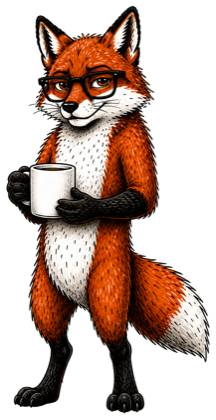
There's a fox on my website now.
If you've been to AndrewFogliato.com lately, you've probably seen him. He peeks out from behind the homepage. He reads next to my articles. He inspects things. He sits by the footer with a coffee if you scroll far enough to earn it. And sometimes, if you stick around long enough, you may even see him walking across the bottom of your screen like he's late for a meeting he didn't want to be in.
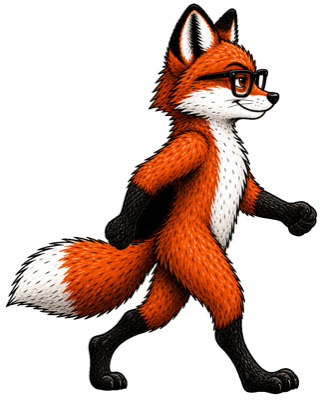
His name is Terry. Here's how he got here. It doesn't start where you'd think.
The real reason first
Before the fox story, the honest answer about why any of this exists.
This website is an experiment in teaching myself AI. That's the whole thesis. I run Real Estate Magazine, I speak on stages about where marketing is going, and I don't ever want to be the guy talking about AI who hasn't actually built anything with it. So I learn by shipping. The site itself was lesson one: an AI built it, in public, transcripts and all.
Terry is the next set of lessons. A character forces you into problems a website alone never gives you. How do you keep a character visually consistent across dozens of images when AI famously can't draw the same thing twice? How do you animate something and make it look decent? How do you get two different AI tools to work on the same project without stepping on each other? How do you make any of it useful instead of just cute?
I don't fully know yet. That's the point. Every Terry problem is me figuring out how to do something with AI that I didn't know how to do the month before. The fox is just the fun way to keep score.
It started with a question about REM
Terry wasn't originally an idea for my personal site. He started with a question I asked about Real Estate Magazine: should REM have a mascot? Think Clippy, but useful.
Not a logo with eyes. A character with a job. Something that could sit beside a chart and point at the number that actually matters. Something that remembers what an executive said about the same topic three years ago.
The first candidate was a pigeon. I want that on the record.
And honestly, the logic held up. Pigeons are everywhere. They see everything. They somehow always know what's going on. Carrier pigeons literally delivered the news. Nobody else in Canadian real estate was ever going to own a pigeon.
But I like foxes. A fox is clever, curious, a little skeptical, always paying attention. Which is exactly what you'd want from an industry character. And a red fox fits REM's red, black, and white brand almost suspiciously well.
Naming him took longer than designing him
The test for the name was simple: it should sound like a veteran reporter who's been covering this industry for thirty years. A normal, slightly old-fashioned name. Nobody was ever going to take "REMmy" seriously. Including me.
We went through the whole newsroom. Gord. Frank. Murray. Norm. Al. Stan. "Gord's Take" almost won.
Then the answer showed up the way good answers usually do. We deleted something. An early version of the character wore a red-and-white plaid toque, because we were trying to make him quietly Canadian. The fix was to lose the toque and put all of the Canadian into the name instead.
His name is Terry. He's a fox.
If you're Canadian, take a second.
One rule came with the name and it's permanent: it stays at the level of wordplay. Terry will never look like, joke about, or trade on the legacy of the actual Canadian hero. His name is Terry. He's a fox. That's the whole bit, and it never gets explained on the site. You're reading the only explanation I'll ever write.
Then I almost killed the whole thing
Here's the useful part if you're thinking about doing something like this for your own brand.
There's an obvious objection, and it deserved a real answer instead of a shrug: doesn't a cartoon fox undermine us? REM covers people's careers. Companies collapsing. Lawsuits. Policy. A fox wandering through that is a real risk, not a made-up one.
So I stress-tested it. Ogilvy would ask if the fox sells anything. Rory Sutherland would say that in a category where every brand looks the same, a fox who climbs out of a chart is impossible to copy without obviously copying you. Ben Thompson would ask if the character represents something real about the product or is just decoration. And any magazine editor worth their salt would ask the killer question: what happens when the fox walks across a story about layoffs?
The answer that survived was a boundary. And the boundary made the whole idea better.
Terry doesn't work for REM Magazine. Terry works for me.
No fox in the newsroom. No fox near the journalism. REM stays REM. Terry follows me: my site, my marketing work, the teaching and experimenting side of things. Where I'm reporting, no fox. Where I'm working on ideas, the fox comes to work.
One rule got written down that I'd hand to anyone building a character:
Terry can make things less stuffy. He can never make the subject less serious.
So he moved into the website an AI built
Once Terry worked for me instead of the magazine, the launch was obvious. He moved into the experiment.
No announcement. No "MEET TERRY!" campaign. At some point this summer, visitors just started noticing a fox. He peeks out from the edge of the homepage. There's a handwritten note by my photo admitting he does most of the heavy lifting. And if you get curious, there's a little link at the bottom of every page: Who's Terry?
The whole character runs on one line:
Terry knows he's inside a website, because he helped build it.
He's not a mascot waving from a corner. He's definitely not a chatbot bubble. He treats the website like a physical space he works in. As far as Terry's concerned, when you visit my site, you're in his office.
His personality, for the record: competent, unimpressed, and suspiciously lucky. He'll tell you none of this is technically his job. He does all of it anyway. There's a sample exchange on his page that sums up the working relationship:
It took two AIs and a human to make one fox
This is the part I find genuinely funny. Terry required an assembly line.
The idea and the taste calls were mine. ChatGPT designed the character: the poses, the personality guide, the behaviour rules, and eventually a 42-image asset pack. Then Claude Code, the AI that actually builds and runs this website, took all of it and wired him in.
The spec ChatGPT wrote for its AI coworker included my favourite sentence of this whole project: "One thing I would not let Claude improvise is the character art. Give it approved assets. Otherwise you'll get five slightly different Terrys and the illusion breaks immediately."
One AI writing rules to keep another AI in line. We live in the future, and the future is mostly project management.
And this is where the "teach myself AI" thesis stopped being theoretical. Almost nothing worked the first time. The first time I handed Claude the kit, it came back with a gap analysis instead of a fox: the asset folder was empty, the concept mockups included a newsletter subscriber count that doesn't exist, and the whole "Terry built this" bit collided with the site's actual origin story. The first walk animation was worse: ChatGPT's animation frames turned out to be four drawings of four different foxes. Claude flagged it, I sent ChatGPT back with much stricter instructions, and the second batch worked. Now Terry actually walks. Legs and everything.
Every one of those failures taught me something specific: how to spec assets so an AI can't improvise, how to check character consistency, how to make two tools hand work to each other cleanly. That's the education. The fox is the receipt.
Everything got fixed before it shipped, because the standing rule of this experiment hasn't changed: we don't make anything up. Terry is fiction. Everything around him is true. The Who's Terry page says both, in that order.
The restraint is the product
The character was the easy part. The rules are what make him work.
The still versions of Terry are placed deliberately, one moment per page, never near anything serious. But the moving stuff is rare on purpose. The walk across your screen has roughly a 12% chance of happening, and only after you've actually been reading for a while. There's a cooldown between appearances. He never does the same trick twice in one session. If you catch him mid-walk, you got a little lucky. He'd say he let you see him.
He never blocks content. He never goes near the contact form. If you browse with reduced motion on, he stays still.
He rarely speaks. The situation is the joke.
And he's measured. I can see in my analytics how many people actually catch him. If Terry ever hurts the numbers that matter, he's one setting away from a vacation. That's the difference between a gimmick and an experiment. An experiment can be turned off.
There's even a 404 page now. Terry's digging through a cardboard box, insisting: "Andrew definitely gave me this page."
Where this goes
Terry works for me, so he goes where I go. This site first. My content next. Eventually the marketing and education side of what we're building at REM. Maybe one day "Ask Terry" is a real research assistant with a real archive behind it. That one has a rule already written too: if Terry says he analyzed 300 websites, then 300 websites got analyzed.
The magazine? Never. Terry is not allowed in the newsroom. Though I won't pretend we haven't talked about a drawing of him staring sadly through a glass door marked EDITORIAL.
And the learning list keeps going. Better animation. Smarter behaviours. Keeping him consistent as the asset library grows. Making him genuinely useful instead of just charming. I don't know how to do all of that yet, which is exactly why he exists.
As of this week, his face is literally the favicon. The fox is the brand mark of the experiment now. There's no going back.
Go say hi. He probably won't say anything.
That's the character.